
From wet clay to finished ware
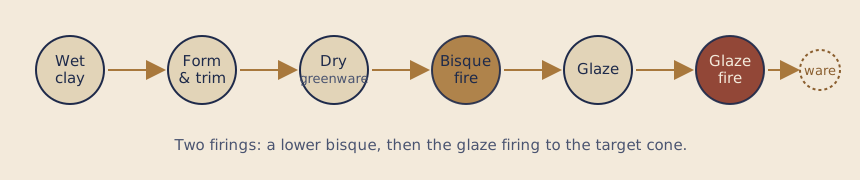
The full studio workflow, in order. Each stage has its own failure modes, and a piece can be lost at any of them.
Wedging
Kneading the clay to remove air pockets and homogenise moisture. Air pockets remaining in the clay can expand explosively in the kiln. Wedging also aligns the clay particles for throwing.
Forming
Pinching, coiling, slab, throwing, or casting (see section above). Output is a "green" piece — wet clay holding its shape but very fragile.
Leather-hard / Drying
The piece dries gradually to leather-hard (firm but still cool to the touch, can be carved or trimmed) and then to bone-dry (room-temperature, very fragile, ready for firing). Rushing drying causes cracks.
Trimming & Finishing
At leather-hard, the foot ring is trimmed, surfaces refined, handles attached (with slip-and-score), decoration carved or impressed. Last chance to fix shape.
Bisque Firing
First firing, typically to cone 08–04 (~950–1060°C). Drives off chemically bound water, burns out organics, converts soft clay to a hard but still porous body suitable for glazing.[Bellevue College]
Glazing
Glaze applied to bisque ware by dipping, pouring, brushing, or spraying. Application thickness changes how the glaze fires — tenmoku and celadon both require deliberate thickness control.[CMW]
Glaze Firing
Second firing, to the maturation temperature of the clay body and glaze: cone 04 for earthenware, cone 6 for mid-fire stoneware, cone 10 for high-fire stoneware / porcelain. Atmosphere (oxidation vs reduction) is chosen here.
Unloading & Inspection
Kiln must cool slowly (usually overnight) to prevent dunting (cracks from thermal shock). Pyrometric cones inside the kiln are inspected to confirm heat-work actually delivered.[Orton]
