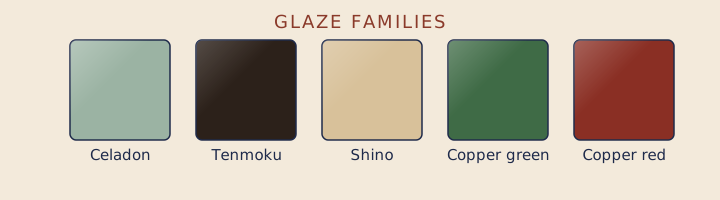
Most of the major historical glaze families are variations on two colourants: iron
oxide (celadons through tenmokus) and copper oxide (oribe and copper reds). Behaviour
depends on percentage and atmosphere.
Representative colours of the major glaze families.
Drop a photo here: glazed ceramics or glaze jars (e.g. Unsplash “glazed ceramics”)
Celadon
iron < 2% · reduction
Transparent green to blue-green glaze coloured by small amounts of iron oxide
(typically 0.5–2%) fired in reduction.[Garland, Digitalfire]
Traditionally fired around cone 10 (~1300°C); cone 6 versions
exist but purists distinguish them.
Originated in Chinese kilns from the Shang dynasty onwards; mastered at Longquan
in the Northern Song.[Ippodo]
Tenmoku
iron 8–12% · high-fire
Iron-saturated glaze that fires glossy black to deep brown.[CMW]
Subfamilies include hare's-fur (vertical iron streaks), oil-spot / yuteki (silver
iridescent spots from iron crystals, often fired in oxidation), and yohen
(iridescent multicolour from controlled crystal growth).
Classic versions are cone 10 reduction.
Shino
feldspathic · reduction
Originally Japanese (Mino, late 16th c.). A high-feldspar glaze fired in reduction
that traps carbon to produce orange-to-grey surfaces with characteristic crawl and
pinhole texture.[Garland]
Oribe (Copper Green)
copper · oxidation
Copper-bearing glaze, vivid green in oxidation. Named after the Mino ware style
popularised in 17th-century Gifu Prefecture.[Musubi Kiln]
Copper Red (Lang Yao / Sang de Boeuf)
copper · reduction
The same copper colourant as Oribe, but fired in reduction — produces a deep
red instead of green. Famously difficult to fire consistently. Reduction strips
oxygen from copper, shifting it to the elemental form responsible for the red.[Digitalfire]
Ash Glaze
natural · wood-fire or applied
Wood-ash-based glaze, the historical root of East Asian glaze traditions. Either
deposited naturally during wood firing or applied as a slip. Behaviour depends
heavily on the species and combustion temperature of the source wood.