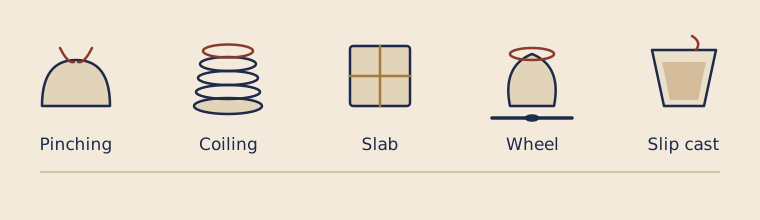
Pottery forming techniques are conventionally grouped into three families:
hand-building (pinching, coiling, slab), wheel throwing, and slip casting.[Wikipedia]
Industrial methods (jiggering, ram pressing, injection moulding) are out of scope
for studio practice.
The five primary forming techniques.
Drop a photo here: hands at the wheel or hand-building (e.g. Unsplash “pottery wheel hands”)
Pinching
hand-building · smallest scale
The oldest and simplest technique: a ball of clay is opened with the thumb and walls
are gradually pinched outward.[Wikipedia]
Best suited to palm-sized vessels — pots, bowls, cups — where wall thickness
can be controlled by feel.
ScaleSmall
ToolsHands
No equipment neededAsymmetric by nature
Coiling
hand-building · large & tall forms
Construction by winding long cylindrical rolls of clay on top of one another,
allowing each layer to firm up before the next.[Wikipedia]
Permits greater shape variety than throwing — coils can build any silhouette
including extreme curves.
ScaleLarge
ToolsHands
Slip & score joinsCombinable with wheel
Slab Building
hand-building · geometric forms
Flat sheets of clay are rolled out (slab roller or rolling pin), cut to shape,
and joined.[Artsper]
The only handbuilding technique that naturally produces flat planes — ideal
for boxes, tiles, and angular sculpture.
ScaleMed-Lg
ToolsRoller
Leather-hard assemblyGeometric friendly
Wheel Throwing
wheel · symmetrical rotation
A lump of clay is centred on a spinning wheel and shaped by the potter's hands as
it rotates.[Wikipedia]
The fastest path to symmetrical rotational forms (cylinders, bowls, plates) and
the most iconic ceramic technique. Steep learning curve compared to handbuilding.
ScaleSm-Med
ToolsWheel
Rotational onlyEquipment required
Slip Casting
mould · complex / repeatable forms
Liquid clay (slip) is poured into a porous plaster mould, which absorbs water
and builds a clay layer against the mould wall. Excess slip is poured off,
leaving a hollow shell that conforms exactly to the cavity.[Wikipedia]
The only technique that produces identical copies and supports undercuts /
square forms / very thin walls.